
Demand for AI Expertise Far Outpaces Wage Growth

AI-related job postings have grown nearly ninefold since 2022, but pay has risen only 39%, and new hires are pulling ahead of employees who upskill.
AI is moving out of pilot projects and into everyday operations. Two signals make that shift hard to ignore: how many employers are hiring for AI expertise, and how much they are willing to pay for it. Right now, those signals are moving at very different speeds. The demand for AI expertise has multiplied several times over in under five years, while AI salaries have climbed at a far gentler pace.
The result is an AI labor market where companies are chasing talent they can’t easily find, pricing roles they can’t reliably benchmark, and managing employees who expect to be paid for skills they’re building on the job. Here’s what the latest data reveals about the gap, and what it means for compensation planning.
Demand for AI Expertise Far Outpaces Wage Growth: The Numbers
According to labor market analytics firm Lightcast, U.S. employers posted 9,241 AI-related jobs in January 2022, with a median advertised pay of $106,080. By August 2026, the latest month with available data, postings had reached 80,597. That is about 8.7 times the starting figure, a 772% increase, with growth accelerating year over year.

AI wage growth tells a more modest story. Median pay in those postings rose to $147,500, an increase of roughly 39% over the same stretch.
AI Job Demand Versus Salary Growth at a Glance
Metric | Jan 2022 | Aug 2026 | Change |
AI-related job postings | 9,241 | 80,597 | +772% (8.7x) |
Median pay in AI postings | $106,080 | $147,500 | +39% |
Annualized, postings grew by roughly 60% a year while median pay rose about 7% to 8% a year. That pay trajectory still beats the typical 3.5% annual raise by a wide margin, so AI talent is clearly being rewarded. But the AI skills demand curve is so much steeper that the two lines are drifting apart rather than converging. In Payscale’s view, this is exactly where crisis conditions form: job growth without matching wage alignment.
Why Demand for AI Skills Is Growing
For years, the dominant story about AI was job loss. Payscale’s research challenges that framing by looking back at earlier waves of technology. In 1913, Ford’s assembly line cut the time to build a Model T from about 12 hours to 1.5 hours, fueling fears of mass unemployment. Electronic spreadsheets were supposed to make accountants obsolete. Instead, the profession expanded as accountants served more clients and took on deeper analysis. The internet followed a similar arc.
The report argues that AI is on the same path: less wholesale displacement, more augmentation, with people learning new skills, working faster, and focusing on higher-value work. That changes the question for the AI workforce. The issue is no longer how many jobs disappear, but how to hire for emerging skills, reskill current staff, redesign roles, and pay people fairly for the new value they create. It also explains why the AI talent shortage, not layoffs, is the more immediate risk.
AI Job Growth Isn’t Uniform Across the AI Labor Market
Industries With the Most AI-Related Jobs
Professional, scientific and technical services led all sectors with 20,500 AI job postings in August 2026, well ahead of manufacturing (10,255), information (9,063), and finance and insurance (7,995). Information, administrative, and support services led AI hiring demand early on, but professional services overtook them and widened the lead.
Where AI Salaries Are Rising Fastest
Pay growth doesn’t follow posting volume. Real estate saw the strongest AI wage growth, followed by arts and entertainment and information, each with median pay gains above 85% since early 2022. Payscale suggests AI may give real estate firms a time-sensitive edge in spotting investment opportunities, pushing both demand and pay upward. Information-sector AI roles are the highest paying overall, likely because the data security stakes are highest there.
One detail matters for finance teams: finance and administrative and support services recorded comparatively weak wage growth in AI-related roles over the period, even though finance and insurance ranks fourth in posting volume. Finance leaders benchmarking only against their own industry may build offers that look competitive on paper yet fall short against faster-moving sectors competing for the same AI talent.
Salary Structures Are Struggling to Keep Up
Payscale’s AI Workforce Impact Report preview draws on two surveys fielded in August 2026: one of 500 employers and one of 1,000 employees. Among employers, 61% said they are rewriting job descriptions because of AI. Roles are being rebuilt around capabilities such as AI fluency, prompt engineering, and model oversight, skills that traditional salary surveys often don’t capture.
The 13-Point Benchmarking Gap
Yet only 48% of employers acknowledged that their current benchmarking no longer reflects the AI skills many roles now require. Payscale treats the 13-point difference between those two figures as a warning sign: organizations are redesigning jobs faster than they can price them. The fallout can include roles with no clear market value, inflated offers, and new hires paid differently for the same work. Internally, 49% of employers admitted their salary structures haven’t kept pace with roles reshaped by AI.
The AI Skills Shortage in the Workforce Is Already Here
Four in ten employers (40%) say they struggle to find candidates with sufficient AI fluency. Payscale frames this and the push toward training as the same problem seen from two sides: when the market can’t supply the AI talent you need, you have to build it yourself.
AI Upskilling as the Answer to the AI Talent Shortage
Three-quarters of employers (74%) plan to invest in AI upskilling within the next 12 months, while 12% do not and 14% are unsure. Payscale defines this investment broadly, covering internal training, external partnerships, and hiring for new AI capabilities. Developing internal AI talent can ease scarcity, but it creates a new pressure point on pay.
AI Skills and Employee Compensation
On the employee side, 56% believe workers who develop new AI skills should earn more, compared with 24% who disagree and 20% who are unsure. And they aren’t inclined to wait. Traditional salary surveys can trail the market by a year or two, yet external candidates expect premiums immediately, current employees expect raises that reflect their new abilities, and budgets aren’t growing to cover both.
The Hidden Risk in AI Upskilling and Employee Retention
The sharpest tension sits between new and existing staff. External hires with advanced AI skills can command premiums of 20% to 40%, while tenured employees who learn the same tools on the job often see no comparable increase because their pay sits inside outdated structures. Payscale warns this breeds resentment and sets up a serious retention problem. The irony is that a successful AI reskilling program can produce employees who are more marketable elsewhere and underpaid where they are.
How AI Is Changing Compensation: A Scatter of Strategies
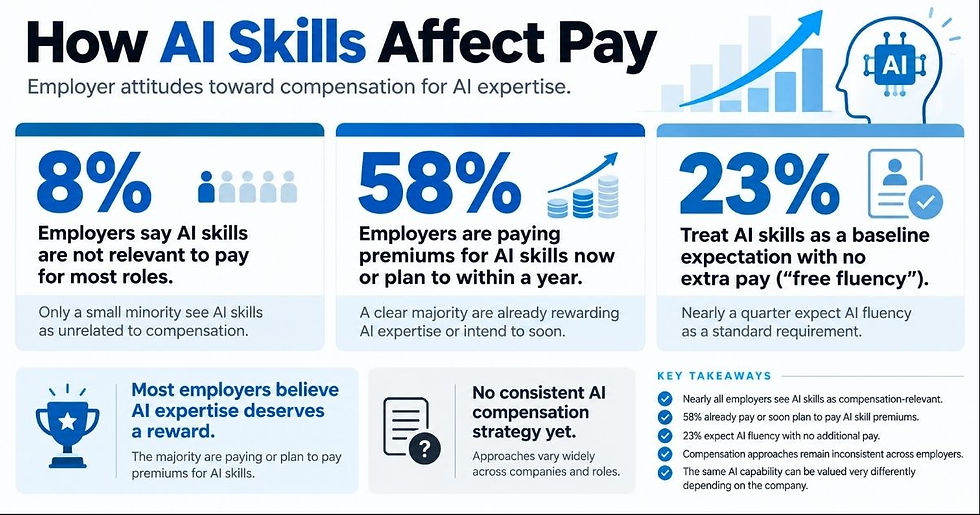
Only 8% of employers say AI skills aren’t relevant to pay for most of their roles. Nearly everyone else agrees AI expertise deserves a reward, and 58% are paying premiums for AI skills now or plan to within a year. But without market data to anchor decisions, there’s no consistent AI compensation strategy. Asked how they handle pay for AI-related roles (multiple answers allowed), employers responded:
Approach to Compensation for AI skills | Employers |
Currently pay a premium (higher base or incentive pay) | 33% |
Updating salary ranges to reflect AI responsibilities | 27% |
Expect to introduce AI pay premiums within 12 months | 25% |
Paid a premium at first, now treat AI fluency as required | 23% |
Reward AI skill development via bonuses, promotions, or other incentives | 22% |
Maintaining existing structures regardless of AI requirements | 19% |
Expect pay for highly automated roles to grow more slowly | 13% |
Still evaluating their strategy | 13% |
AI skills not relevant for most roles | 8% |
The 23% group deserves attention. Payscale calls this “free fluency”: treating AI as a baseline skill candidates should already have, with no extra pay attached. Combined with premiums, frozen structures, and wait-and-see approaches, the outcome is widely dispersed pay for the same capability. For workers, a given AI skill can be worth very different amounts depending on the employer.
Building a Compensation Strategy for AI Expertise
Here are some recommended fix is to establish the going rate for AI-fluent versus non-fluent talent in specific roles, then apply that skills differential to base pay or total rewards. In practice, that means:
Price skills, not just titles. Where job descriptions have changed, benchmark the actual skill mix rather than a title that hasn’t been updated in years.
Refresh market data more often. Annual survey cycles can’t keep pace with a market being repriced in real time.
Close the internal–external gap. Give upskilled employees a path to a differential comparable to what new hires receive, through base adjustments, bonuses, or promotions.
Decide premium versus baseline on purpose. If AI fluency becomes a requirement, say so clearly and pair it with training instead of letting it happen by default.
Link upskilling budgets to pay budgets. AI skills development without a reward plan can speed up turnover rather than prevent it.
A Note on the Data
Both Payscale surveys were fielded online through Dynata and covered organizations with 100 or more employees. Employer respondents were HR, compensation, and talent acquisition leaders; employee respondents were full-time workers and active job seekers. Job postings data comes from Lightcast’s Artificial Intelligence Sector. Payscale notes the findings may not apply to smaller firms, reflect HR’s perspective rather than frontline or tech teams, and capture stated intent that may differ from action. Given how fast the market is moving, the numbers are best read as a snapshot. The full report is due in November 2026.
Pay Must Catch Up With the Growing Demand for AI Expertise
The growing demand for AI expertise isn’t slowing down, but compensation practices haven’t caught up. Employers are rewriting jobs, investing in AI upskilling, and competing for scarce talent, all while relying on benchmarks and salary structures built for a different market. Organizations that price AI skills with current data and reward the internal talent they train will be far better positioned to keep the people they’re investing in.


Comments